

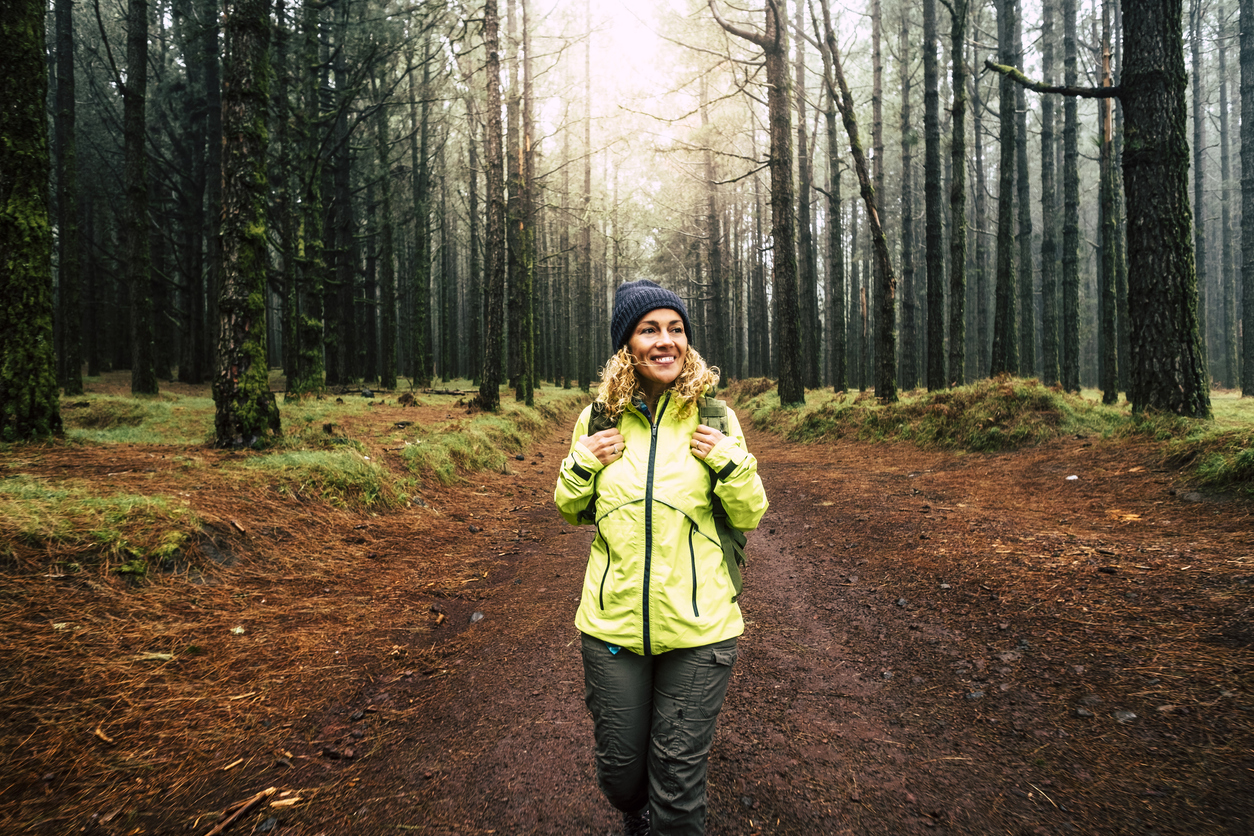
Sarah Grocutt goes walking in the forest to discover how nature can deliver a journey to better wellbeing and improved health and discusses why forests are particularly potent.
Walking is one of the most accessible and simplest ways to improve health and wellbeing. A brisk walk burns calories and improves cardiovascular fitness, but walking beneath a canopy of trees may offer additional rewards for both body and mind.
The forest environment offers more than a scenic backdrop for a walk; it can influence how we feel, think and move, making it a powerful setting for both fitness and wellbeing. My MA in Outdoor Education explored how natural environments can shape our experiences of movement and health, and forests emerged as a central theme because they combine both physical activity with sensory immersion, encouraging participants to slow down, notice their surroundings and connect and engage with the natural world.
Most of this took place in a vast forest landscape; the research took place in woodlands in Europe and forest landscapes in Asia – contexts where nature-based wellbeing practices have already held long traditions.
The experiences of those interviewed during one study mentioned that the forest offered restorative ways that extend beyond the physical benefits of walking. The research also provided an opportunity to examine how cultural attitudes towards forests and nature-based wellbeing differ, while revealing a common similarity, such as time spent walking among trees can have profound benefits for both physical, emotional and mental health.
For example, research into long-distance solo female hikers who chose natural forest landscapes in Italy for their walk showed that walking offered participants an opportunity to step away from the distractions of life while engaging with their emotions, which led to increased wellbeing.1
This is supported by Lumber et al, who show how emotion and beauty are pathways for nature connectedness, through focusing on the aesthetics of nature and preferred natural environments, such as waterfalls, fjords, mountains and interesting landscapes.2 Further, Capaldi et al demonstrate the different ways participants seek out opportunities to reap the psychological benefits associated with nature exposure. They state that individuals who seek out opportunities to connect with nature will reap the psychological benefits associated with nature, such as walking in a forest.3
Forest bathing
Forest bathing is the mindful practice of immersing oneself in the atmosphere of the forest, whereas forest therapy is a more structured practice involving activities to improve physical, mental and emotional needs. Rahoo et al suggest that, although there is research emerging from across the globe into forest bathing and therapy, Japan was one of the first to recognise the concept of forest bathing, which was first developed by the Japanese Forest Agency in 1982.4 In Japan, it is known as shinrin-yoku.
There has been growing interest in forest therapy research across Europe. These studies usually focus on forest therapy’s effects on human health from physiological and psychosocial perspectives, but there are also studies on its potential in treating specific illnesses such as hypertension and depression. Further investigations on the psychological benefits of walking in a forest environment show that walking around and viewing forests improved emotional state, such as tension and anxiety, depression, anger, hostility and fatigue, leading to psychological relaxation.5 The research also reported that walking and being in a forest decreases feelings of depression and increases liveliness.5
This is supported by Le Gear et al, who also suggest that immersion in forest therapy activities reports benefits of mental health, improved immune function, pain relief, cognitive function and hypertension.6 Research on young women walkers who undertook shorter distance walks in various forests and cities across Japan suggests there was a significant increase in parasympathetic nervous system activity when walking in a forest area compared to walking in a city, and that the participants reported feeling more relaxed and comfortable in the forest environment.7
Similarly, Rahoo et al claim there are many findings to suggest that spending time in a natural environment can reduce stress4 and studies have found that urban environments can have a negative impact on physical and mental health, possibly due to urban stressors such as increased noise levels and pollution.
Engaging the senses
There appear to be many forms of different forest therapy programmes, ranging from walking and stretching to connection with nature and water in the forest, such as streams and waterfalls.
Walking in a natural forest environment combines physical activity with a rich sensory experience that can benefit both body and mind. As we know, any walk is good but forests provide a unique setting where nature and movement work together to enhance wellbeing.
For example, while walking among trees, where the sights, sounds and atmosphere of the forest create an experience to enhance exercise – such as noticing the shadows of the sunlight as this filters through the trees, the sound of footsteps as we walk, the sound of the birdsong and the scents of pine, leaves and damp earth – forests engage our senses in ways that urban environments rarely can. Thus, the forest environment offers more than a scenic backdrop for a walk; it can influence how we feel, think and move, as the forest provides a natural space that encourages both physical activity and mental restoration.
It can be difficult to isolate the different elements of the forest experience, such as greenery, fresh air, sunlight, aromas from different trees, flowers and plants and how this links to improved health benefits. However, Miyazaki claims it is important to enjoy the forest activity; experiments conducted in subjects in Japan who listened to the sound of the forest stream had their brain activity and blood pressure monitored and measured and those who found comfort in the forest experience underwent greater physiological relaxation and a reduction in brain activity.8
A different perspective on forests and wellbeing
Research has explored the effects of different forest environments and tree species on health and wellbeing. According to Lye et al, bamboo forests are an important forest type across many countries, particularly in East and South Asia, as well as parts of Africa.9 Bamboo is especially valued in Chinese landscapes for its distinctive appearance and cultural significance.
In a study conducted in China, Lye et al examined the effects of a three-day bamboo forest experience compared with an urban environment among male college students.9 The findings revealed improvements in psychological wellbeing, including enhanced positive mood states and reduced negative emotions. Participants also demonstrated physiological benefits, including improvements in immune function. These findings suggest that different forest environments may offer unique opportunities to support both physical and mental health.
If forests are different from other places to walk, part of the answer lies in the relationships people have with them. One of the highlights of attending the Nature Adventure Therapy Conference in Taiwan in 2025 was spending a day with an Indigenous community and learning about their relationship with the surrounding forest. As we walked through the woodland landscape, we listened to stories, traditions and local knowledge that revealed a connection to nature extending far beyond recreation.
The forest was not viewed as a separate place to visit or escape to but as an integral part of daily life, culture and community. It provided food, resources, opportunities for learning and a strong sense of identity that had been passed down through generations. This experience offered a valuable reminder that wellbeing is not only about individual physical and mental health, but also about belonging, connection and our relationship with the natural world and the places we inhabit.
Forest walking is accessible, affordable and suitable for people of all ages and abilities. Beyond the physical benefits of movement, forests offer a unique environment that can support mental wellbeing, recovery and connection. Whether viewed through the lens of scientific research or cultural traditions, forests remind us that wellbeing is influenced not only by how we move, but also by where we move and the connections we make along the way.
Discover more about wellbeing in nature with this post on open water swimming on the FitPro blog.

Sarah Grocutt BSc (Hons) Science, QTLS, MA Outdoor Education is a qualified science teacher, Pilates instructor and outdoor practitioner who combines walking and Pilates in outdoor settings to support physical and mental wellbeing. To find out more about her work, visit www.fitness-excel.com
References
- Grocutt, S. and Wood, C. (2025) ‘Walking with purpose: eight solo women’s pilgrimage and hiking experiences on the Via Francigena’, Journal of Outdoor Recreation and Tourism, p.4.
- Lumber, R., Richardson, M. and Sheffield, D. (2017) ‘Beyond knowing nature: contact, emotion, compassion, meaning, and beauty are pathways to nature connection’, PLOS ONE, 12(5), e0177186, p. 19.
- Capaldi, C.A., Dopko, R.L. and Zelenski, J.M. (2014) ‘The relationship between nature connectedness and happiness: a meta-analysis’, Frontiers in Psychology, 5, pp. 1–10.
- Rahoo, K.S., Karam, D.S. and Abdullah, M.Z. (2020) ‘The physiological and psychosocial effects of forest therapy: a systematic review’, Urban Forestry & Urban Greening, p. 2.
- Song, C., Ikei, H., Park, B.-J., Lee, J., Kagawa, T. and Miyazaki, Y. (2018) ‘Psychological benefits of walking through forest areas’, p. 2.
- Le Gear, K., Caitriona, C. and Gerald, F. (2023) ‘Deep Roots: realising the public health benefits of exposure to forest environments’, Advances in Integrative Medicine, p. 1.
- Song, C., Ikei, H., Kagawa, T. and Miyazaki, Y. (2019) ‘Effects of walking in a forest on young women’, International Journal of Environmental Research and Public Health, pp. 5–7.
- Miyazaki, Y. (2025) Walking in the Woods: Go Back to Nature with the Japanese Way of Shinrin-Yoku, p. 64.
- Lye, B., Zeng, C., Xie, S., Li, D., Lin, W., Li, N. and Jiang, M. (2019) ‘Benefits of a three-day bamboo forest therapy session on the psychophysiology and immune system responses of male college students’, International Journal of Environmental Research and Public Health, p. 12.