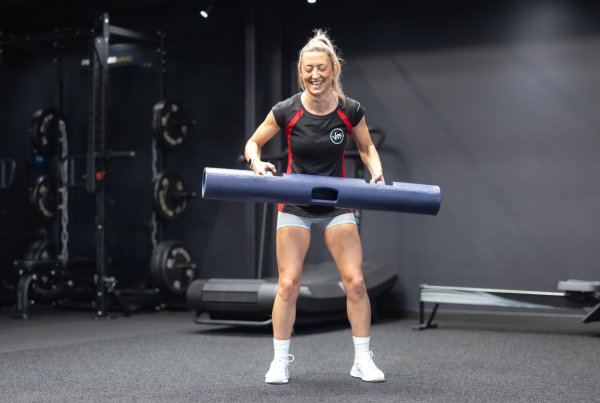

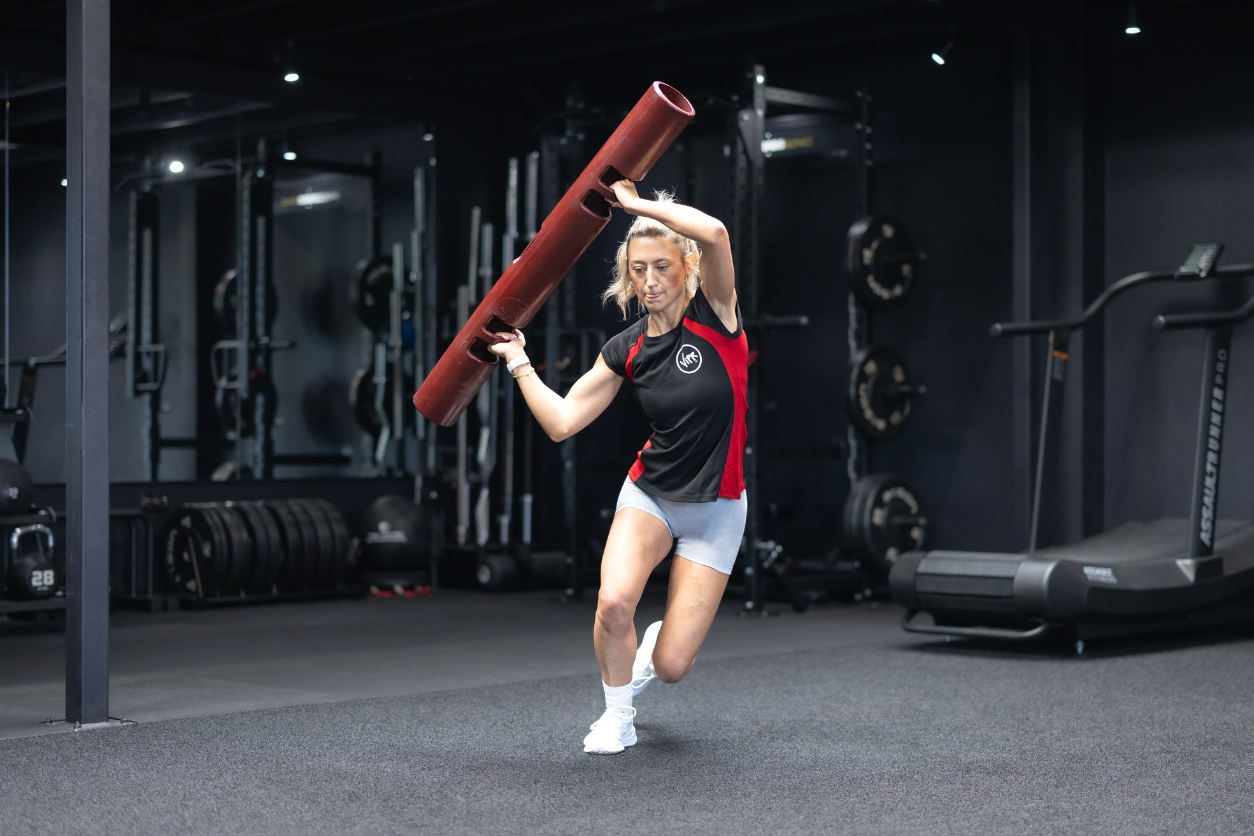
Stephen Tongue delivers a strong woman workout using ViPR, empowering women to move beyond traditional fitness goals and embrace a stronger, more confident version of themselves.
The way men and women train in the gym and what they should or shouldn’t do differently has been a subject of debate for many years. Not only that but perceptions of what exercises are good for women, the weights they should lift and the training goals they strive for have evolved over decades of gym culture.
As the related science within this subject has improved and the understanding of how men’s and women’s bodies adapt to exercise has become clearer, the gap between men’s and women’s gym workouts has closed.
The presence of female-only areas in gyms has decreased, mixed gender classes and workouts are now more common and the language used in male/female gym culture has seen a convergence. Women are increasingly moving away from an aesthetic attitude to working out and, instead, the focus has shifted to strength, athleticism, physical/mental health, confidence and resilience.
As fitness professionals, it is our job to ensure we create an inclusive workout environment that empowers all populations to move better, feel better and become healthier without being judged and while enjoying the process. ViPR and the Loaded Movement Training (LMT) concept are tools that are built for everybody, have no limitations on programming or performance, and encourage systematic progression and a positive, interactive coaching style between client and trainer.
Performance and programming
As a young trainer breaking into the fitness industry 25 years ago, I recall a definite gap in perceptions of what men and women should train for. I remember a distinct focus on cardio, ‘toning’ muscles in isolation and fitness classes for women. In men, a trend of focusing on heavy lifting, free weights and muscular size seemed popular. Thankfully, these attitudes are now outdated and a shift towards resistance training carrying much-needed health benefits to everyone is widely accepted, as well as the need for more functional exercise that has a greater carryover into everyday life, sport and physical/mental health.
ViPR again facilitates functional resistance training style with the ability to develop functional strength, flexibility and cardiovascular fitness simultaneously.
What are the differences between workouts for men and women?
Metabolic
The short answer to this is “not a lot”. The notion that men and women should train differently is becoming increasingly outdated. Recent research has shown that men and women respond and adapt in very similar ways with only subtle variations that affect programming and results.
Research conducted by Sarah Hunter et al concluded that women show some fatigue resistance in comparison to men. Women were able to perform more reps over multiple sets at a relative intensity to men, recovering more quickly between sets and demonstrating stamina. This suggests that some women may be able to tolerate slightly higher training volumes than men and require less recovery between workouts, although differences are small and will vary between individuals.
Biomechanical
In addition to metabolic differences, it is also worth noting there will be subtle biomechanical differences, mainly due to how a woman’s pelvis may be wider than a man’s. This may have some implications in exercise position preferences or show up in movement discrepancies. For example, when squatting, a wider or more externally rotated foot position may feel more comfortable than a neutral position and have a small influence on performance. Positional preferences will of course also be applicable to men, as bone and joint variations are present in everyone. This means from a fitness professional’s perspective we should always look to accommodate individual preferences, regardless of gender.
ViPR and LMT encourage the exploration of movement and joint positioning, promoting a better proprioception awareness and understanding of how our individual bodies move.
Hormonal
One other obvious difference that should be accommodated for when training women is the menstrual cycle. Many women report changes in energy levels, performance, physical pain and motivation in relation to exercise; some women may report no change in performance.
Once again, as fitness professionals this tells us we do not need to take a blanket approach to coaching women to accommodate for this, but rather we should look at every client on a case by case basis, communicate and be flexible enough to adapt training plans and workouts during times when that may be necessary.
Fitness professionals should avoid a hard, rigid approach to workout plans and be prepared to deviate from plans where it’s appropriate. With such a broad range of exercises, weights and exercise modifications, ViPR is versatile enough to accommodate changes in training without the need to plan for other workout tools.
Taking in the above considerations, programming and training for women is almost identical to men, with the main approach being that we should be flexible and adaptable enough to treat everyone as individuals, avoid a cookie-cutter approach to programming and be mindful enough to accept that our workout plans may need to be malleable.
As fitness professionals, we have another responsibility to ensure we are giving all clients the best possible workout experience with a focus on improving movement quality, physical performance and confidence and that shape and aesthetics are secondary to good health and quality of life. More so for male coaches, it’s important that the language we use, the exercises we prescribe and the weights we pick up do not feed into old-fashioned stereotypes, limit self-efficacy or serve to undermine a woman’s or indeed an individual’s potential.
Moreover, we should be looking to raise an individual’s expectations of themselves, empower them to make positive changes and celebrate growth in performance and confidence. Although I expect most fitness professionals will coach in this manner, we still work in an industry where lighter kettlebells might be pink and a ladies-only area only has dumbbells from 1-10kg. ViPR not only remains gender neutral but a variety of light, medium and heavy ViPRs provide the opportunity for individuals to programme for vitality, performance and reconditioning.
Now we know that exercise prescription for both men and women is less about gender and more about individual preference, ability and potential, let’s look at some exercises that promote high-quality movement and multi-directional strength – and make us feel confident and powerful.
Strong woman workout
Warm-up
ViPR is great for producing flows – movements that seamlessly blend from one drill to another without having to pause. These movements can be choreographed or spontaneous. A strategic build-up of movement in a flow can serve as a fun and effective warm-up, beginning with spinal movements and progressing to greater use of the hips, shoulders, elbows, knees, feet and hands.
Main workout
This strength circuit will exercise all major muscle groups and joints and facilitate core training throughout.
The following seven exercises should be performed as a circuit with 45sec stations and 15-60secs rest in between exercises depending on ability level.
ViPR strength circuit
- Suitcase Carry Lunge
- Squat Shoulder Swap
- Lateral Lunge and Chop
- 180˚ Thread the Needle
- Ice Skater Lunges
- Squat Rotational Press
- Partial Squat and Uppercut
ViPR power finisher
The final circuit is for a metabolic cardio push for those with advanced cardiovascular stamina who like to finish a workout with a challenge – 45 sec stations and 15-60 secs rest in between exercises depending on ability level.
- Tilt and Forward Jumps
- Side Step and Shift
- Lateral Rainbow
Summary
The ViPR Strong Woman Workout is more than a collection of exercises. It is an opportunity to help female clients discover what their bodies can achieve through purposeful movement and progressive strength training.
By combining dynamic movement patterns, whole-body loading and athletic challenges, ViPR training creates an engaging environment where women can develop strength, confidence and resilience.
When supported by thoughtful coaching and individualised programming, these sessions can empower women to move beyond traditional fitness goals and embrace a stronger, more capable version of themselves.
See more of Stephen’s ViPR workouts in this post on tools for stretching on the FitPro blog.
We have an exclusive offer for Professional FitPro members with 30% off Fitness VIPRs and a free online course in Loaded Movement Training – check your membership emails from us. If you’re not a Professional member, this is the ideal time to upgrade your membership and claim a £45 education voucher on top.
Further reading
- Review: Training Performance Variations Across Menstrual Cycle Phases in Female Athletes and Current Approaches summarises evidence that hormonal fluctuations may affect recovery, thermoregulation, perceived exertion and performance, while also emphasising substantial individual variability.
Recent research has questioned whether menstrual-cycle-based resistance training programmes produce superior strength or hypertrophy outcomes, suggesting coaches should individualise rather than rigidly periodise around cycle phases.
- Hunter, S.K. (2016) ‘The relevance of sex differences in performance fatigability’, Medicine & Science in Sports & Exercise, 48(11), pp. 2247–2256.
- Hunter, S.K. (2014) ‘Sex differences in human fatigability: mechanisms and insight to physiological responses’, Acta Physiologica, 210(4), pp. 768–789.
- Senefeld, J.W., Pereira, H.M., Elliott, N., et al. (2015) ‘Sex differences in fatigability of dynamic contractions’, Experimental Physiology, 100(12), pp. 1649–1662.
- Nuckols, G.L., Overpeck, C.A., Hanson, E.D. and Battaglini, C.L. (2026) ‘The effects of biological sex on fatigue during and recovery from resistance exercise’, PeerJ, 14, e20542. doi:10.7717/peerj.20542.
- Çağlar, E.C. (2024) Training performance variations across menstrual cycle phases in female athletes and current approaches.