
Stretching with tools, and done the right way can be both a positive experience and a time-efficient activity, as Stephen Tongue explains.
There aren’t many clients or members I know that would turn their nose up at the idea of being more flexible. There are, however, a lot of clients and members I know that don’t really want to put the time into stretching and would happily skip their routine when unsupervised. We do know it’s good for us, but it’s not often a training priority. Stretching done the right way and with the right tools can be both a positive experience and a time-efficient activity.
Stretching comes in many forms, and if you go looking, you can find lots of styles, protocols, and endless routines to follow. Stretching has also had some “bad press” in recent years. In a 2020 paper, exercise scientist Dr. James Nuzzo argued that flexibility should be demoted as a major component of physical fitness, noting that it doesn’t predict mortality in the same way that cardiovascular endurance and muscle strength do. Furthermore, researchers like Dr. José Afonso have pointed out that strength training—when performed through a full range of motion—is just as effective as traditional stretching for increasing joint ROM (Afonso et al., 2021).
However, flexibility isn’t irrelevant; it’s about how we achieve it. If your goal is functional range of motion that translates to life and sport, we need to move beyond passive “relaxation” and start looking at Loaded Movement Training (LMT) as the gold standard.
Static Stretching: The Yoga Block as a Bridge
The classic ‘hold and breathe’ approach involves holding a muscle in a stretch, usually for 30 seconds or more, with the aim of gradually lengthening the tissue over time. For the client who is new to exercise, stressed, in pain, or simply “stiff,” static stretching is a vital primary intervention. It provides them with improved ROM and, more importantly, teaches them to relax and relieve muscle tension by activating the parasympathetic nervous system. It’s often a useful tool For teaching them to be more aware of their bodies (proprioception).
For a very inflexible client, traditional floor stretches can be discouraging or even painful. Enter the Yoga Block. A strategically placed block reduces the “threat” perceived by the nervous system by making the position accessible. This moves the client from a state of “bracing” or fighting the stretch to a state of relaxation where they are able to release tension. This is where the magic happens for muscle tension reduction. Below are some classic and useful stretches that I’ve adapted with blocks for the most wooden and rigid amongst us.
Practical Block Transformations:
- The Pigeon Pose: Place a block under the hip to reduce the extreme pull on the glutes and take tension off the knee joint.
- Kneeling Quad Stretch: For those who can’t reach their foot, placing a block under the foot while kneeling allows them to push the pelvis forward comfortably.
- Downward Dog: Putting blocks under the hands gives inflexible individuals just enough height to reduce hamstring intensity and allow for a flatter back.
- Iron Cross: A block under the foot facilitates a straight knee and effective tension without the “fight” of overstretching.
- Seated Adductor Stretch: Blocks under the knees allow the hip joints to “accept” the position rather than fighting it.
Dynamic Stretching: Bands for Neuromuscular Prep
Once a client has built a baseline of tension tolerance, we can introduce more intense forms of stretching. Dynamic stretching is fantastic for warm-ups. It’s a time-effective alternative to a purely cardio warm-up, increasing temperature while enhancing neuromuscular excitability. Starting small and gradually progress range, use rhythm, flow and momentum for a more stimulating stretch.
To take this up a notch, we use Strength Bands. Bands provide “variable resistance” that mimics the elastic properties of our soft tissues. The bands keep tension on the muscle toward the end range, meaning the muscle tissue and the nervous system remain actively switched on. It’s an interactive method that makes the body feel “snappy” and ready for high-velocity work like speed work or heavy lifting. There are lots of great dynamic stretches that I use but here are a few you may not have used where I’ve found strength bands to be useful.
Banded Essentials:
- Banded Lat Stretch: Create length through the back and ‘banana’ your spine away from the anchor.
- Banded Chest Stretch: Step in and out of the stretch to gradually increase ROM while keeping the pectorals active.
- Standing Banded Hip Flexor Stretch: Use the band to help maintain hip extension whilst holding a posterior pelvic tilt and moving the pelvis.
- Banded Hinge Hamstring Stretch. The band is pulling the knee into extension to keep the hamstring long.
- Band Stand Spinal Flexion. Press the midpoint of the back to the ceiling for an active lower back stretch.
Loaded Movement Training: The Ultimate ROM Tool
While blocks and bands have their place, the most effective way to improve functional range of motion is Loaded Movement Training (LMT). LMT involves stretching the soft tissues around a joint under an external load.
As Dr. Afonso explains, strength training involves alternating shortening and stretching—it is essentially “dynamic stretching with extra loading.” This is superior because it places stress upon the muscle fibers as they elongate (eccentric contraction). Research shows that eccentric loading can increase fascicle length (the length of muscle fiber bundles), which improves “stretch tolerance” and functional capacity far better than passive stretching alone.
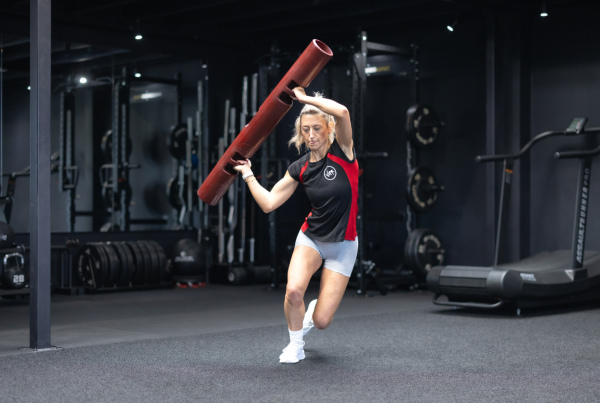
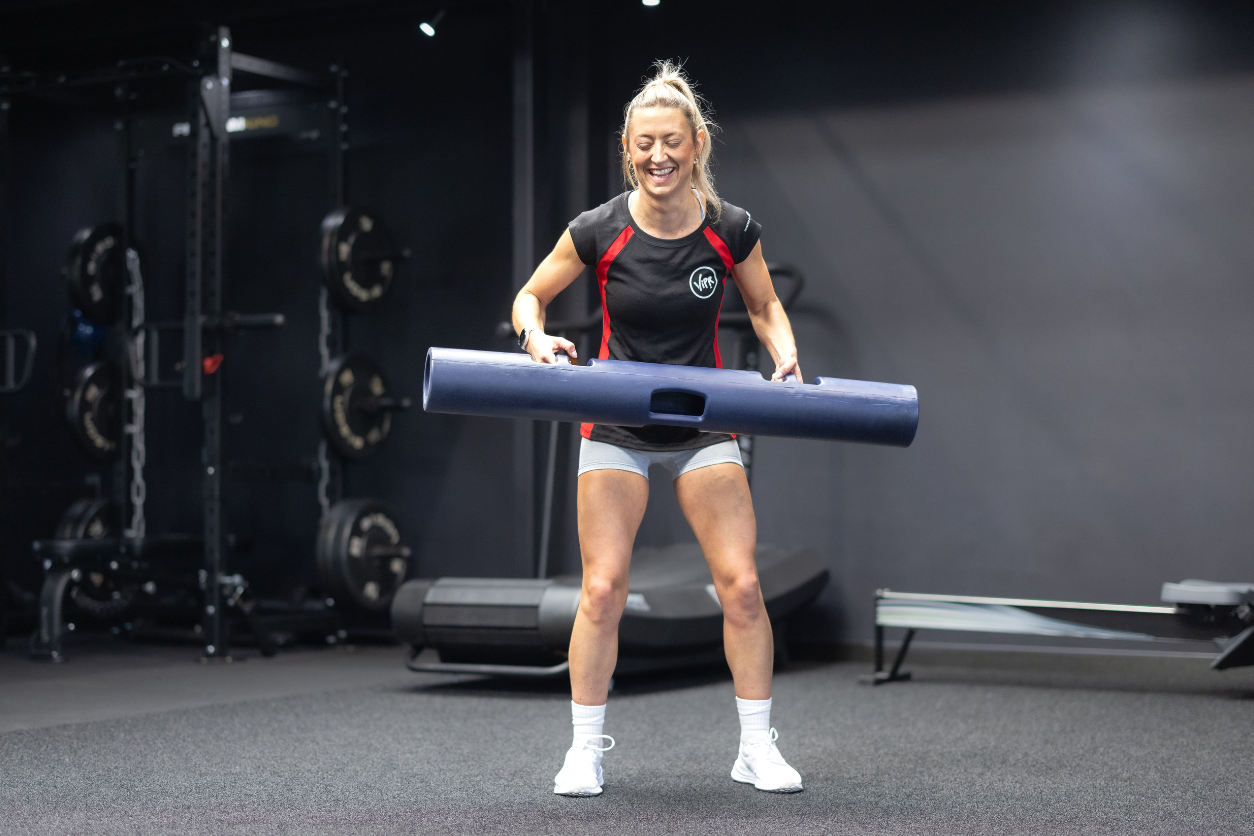
The ViPR (Vitality, Performance, Reconditioning) is the perfect tool for this. It allows the joint to travel through a full 3D range of motion while the muscles are actively controlling that load. This doesn’t just make a muscle “longer”; it makes it stronger and more stable at its end range. Because ViPR is fully scalable—from a 2kg tube to 20kg+—it is accessible for everyone from beginners to elite athletes. Below are some of the go to drills I use with ViPR to get those tissues stretching and flexing.
ViPR Loaded Stretches:
- ViPR Thread the Needle: Push the hips backwards to encourage a hinge pattern and lengthen the hamstrings.
- ViPR Forward Tilt: Allow the tube to pull the hands forwards whilst pushing the hips backwards to lengthen the spine.
- ViPR Cross Lunge & Reach: Challenges the lateral line and hip stability simultaneously.
- ViPR Lateral Lunge & Tilt: Actively stretches the adductors while the nervous system stabilises the pelvis.
- ViPR Posterior Reach & Step: Opens the entire anterior chain (hip flexors and abs) in a functional, upright position.
Summary
If you want to maximise your training time, stop viewing “strength” and “stretching” as two different sessions. By using tools like the ViPR for Loaded Movement Training, you are strengthening the body through its full range of motion. That said some more traditional stretch styles I think still have their place. Use blocks to help the super stiff find the range, bands to prep the range, but use weights and Loaded Movement Training to own the range.
We have an exclusive offer for Professional FitPro members with 30% off Fitness VIPRs and a free online course in Loaded Movement Training – check your membership emails from us. If you’re not a Professional member, this is the ideal time to upgrade your membership and claim a £45 education voucher on top. Or get 20% off your Fitness VIPR now at https://viprfit.com/
References
- James L. Nuzzo (2020) ‘The case for retiring flexibility as a major component of physical fitness’, Sports Medicine.
- José Afonso et al. (2021) ‘Strength training vs. stretching for range of motion: a systematic review and meta-analysis’, Healthcare.