
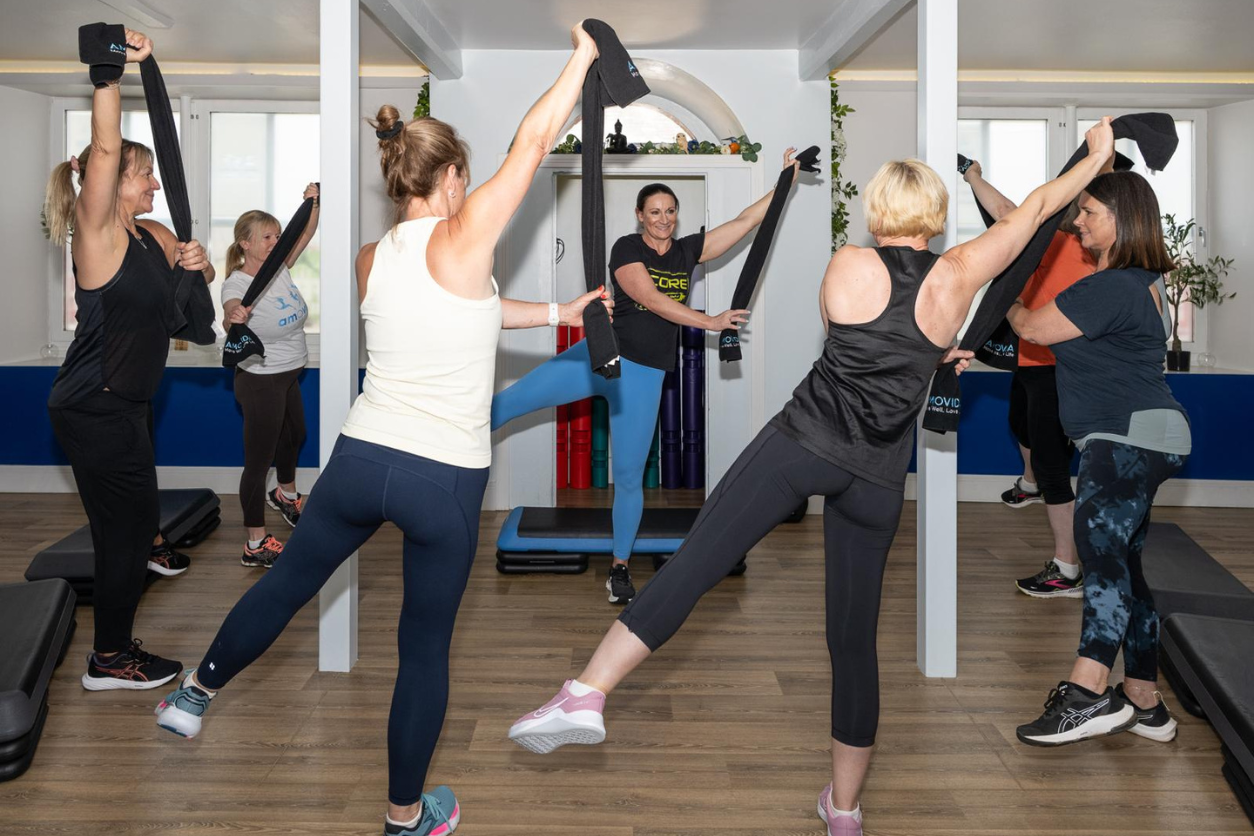
We get right to the core with Ally Taylor as we explore her journey, philosophy and the future of fitness ahead of her online myth-busting seminar about – you guessed it – the core!
FitPro: So, Ally, how did you get started in the fitness industry?
Ally Taylor: It’s a story I’ve told many times and people laugh. After university, where I studied Dance and English Literature, I had no idea what to do. Full-time dancing wasn’t an option because of a couple of back injuries and, unless you go into teaching, those degrees don’t open many doors.
My mum suggested I do a fitness instructor course “while deciding what to do with my life”. So, I did – and the rest is history. I discovered I genuinely enjoyed helping people.
One of my earliest jobs as a fitness instructor was doing an induction with a woman in her 60s. We were supposed to spend one hour together; we spent two. At the end, she hugged me and said, “No one’s ever explained things like that – you’re a gem.” That moment made me realise how good it felt to help someone. Honestly, that feeling is probably why I stayed in the industry.
FP: You were recently featured in The Times. How did that come about?
AT: Completely by surprise! I had written a blog for FitPro about core training – specifically questioning whether we should even use the term ‘training the core’ based on how the core actually functions when we do life or sport, and the way we typically train it isn’t how it functions in life. When we get out of bed that’s our one crunch for the day done!
I’ve done a lot of work with FitPro this year, from FitPro LIVE to the blog to planning the educational event that is happening in January, and someone at The Times found the blog and quoted me. One of my clients forwarded the article because I wouldn’t have known otherwise – we don’t subscribe! They used one line about the core being reflexive and anticipatory and how it doesn’t work in isolation, so perhaps we shouldn’t be training it in isolation if we really want to be robust.
It was validating to see other physios and professionals saying the same thing. It was a lovely surprise – although sadly it hasn’t made me rich and famous just yet!
FP: What has been the biggest turning point in your career?
AT: I’ve been 25 years coming up in the industry, so this is a heavy question! I’ve done quite a large range of things and I really think that every step you take in the industry leads you to where you are meant to end up. The real turning point though was becoming a MOSSA trainer and presenter when they launched in the UK over 10 years ago. That introduction led me to the wonderful FitPro team – Jane, Brent, Teresa Wheatley and more. It opened the door to huge opportunities in education and personal development.
Teaching the PTA Global syllabus came from that too. And while PTA Global is no longer running in the UK, it shaped who I am as an educator.
Another major turning point was being introduced to John Hardy and FASTER. That changed how I look at research, industry narratives and whether things we teach are actually accurate or important.
Everything I do today really traces back to those experiences.
FP: What has been the most fulfilling part of your career?
AT: There are so many moments. Delivering an incredible class where everyone is in the moment together and absolutely loving the experience – whether on stage or in my studio – is always special and makes it feel all worthwhile.
But one-to-one moments with clients are gold: “Thanks to you, I went skiing.” “Thanks to you, I can touch my toes but my brother can’t!”
Those moments remind you that something you’ve done has helped someone live their life better. That’s what keeps me in the industry. It’s certainly not the money!
FP: What sets your approach apart and what philosophies guide your work?
AT: I don’t know that I’m that different – I’m just trying to help the people in my community and make a difference. But a huge shift happened when I learned to question everything:
- Is this true or is it someone’s take?
- Is it evidence-based or cherry-picked or even made up?
- Does it matter? Some things we get hung up on industry-wise probably don’t serve our clients.
- Is it what the data says?
There’s too much unquestioned ‘industry wisdom’ that doesn’t actually help people. My approach is grounded in evidence, practicality and being willing to change my mind when better information comes along. Clinical relevance is where I try and hold ground. I may say something contrary to someone else where there isn’t enough data to be found in a good-quality journal – there is still a lot of making assumptions in the industry.
We’re very quick to say that what we did made someone better, when we don’t actually know if that’s the case. This is why having a broad education and a lot of tools at your disposal is important, so you pick the right tool for the client in the moment. That’s what makes you a good trainer. I’m also open to changing my mind if presented with better evidence, which I think not enough people in the fitness industry are willing to do.
I also refuse to be ‘the person who only uses one tool’. I use whatever suits the client – whether that be ViPR or even squeaky dog toys sometimes!
I also analyse my own programming and ask myself if it was the right call. Being able to research lets me evolve with the science instead of clinging to outdated methods or rushing ahead to promote a new fad that doesn’t actually have enough solid evidence to support it.
FP: What key message do the fitness industry and public need right now?
AT: Choose your sources of information wisely – especially with AI-generated content everywhere. Not everything online is authentic or accurate, and a lot of things are created purely for profit.
Menopause and GLP-1s (weight-loss injections) are being heavily capitalised on. You don’t need menopause-branded moisturiser or a ‘menopause workout’. Women can do whatever workout brings them joy and consistency – and all instructors should understand menopause without stereotyping or boxing woman in. Anyone who is selling anything on the bandwagon – I’d look out for that.
With fewer than 15% of the population getting enough exercise, we should be focusing on getting people moving, not pigeonholing or scaring them. A lot of stuff misses the bigger picture.
FP: What can attendees expect from your 24th January event on core training?
AT: We’ve got four hours online to really deep dive into the crux of core training – not the myths but the reality.
We’ll cover:
- core stability and bracing
- where those ideas came from (spoiler: it’s outdated and refuted research!)
- the eight movements of the spine
- how the core actually functions – reflexively, anticipatorily, in multiple planes
- why floor-based core work is often the least useful option
- how to build upright, dynamic core training that reflects real life
- practical work exploring spinal movement, deceleration and acceleration
- dynamic training systems used in sport but rarely applied in general fitness.
We’ll also look at skill development – how to layer variation so people can perform movements under real-world conditions. If a basketball player only practises a slam dunk from one direction, once the play takes them in a different direction, they’re not going to know how to get the ball in the hoop. We need to look at the skill and how it applies to real life and train the skill, not the core.
Expect myth-busting, evidence, practical tools and lots of ‘aha’ moments.
FP: What inspired you and FitPro to launch this event?
AT: The inspiration was Teresa at FitPro. She’s a fantastic director of FitPro – incredibly forward-thinking and passionate about modernising UK fitness education and dragging it into the 21st century.
She wants to bring education that gives trainers real, usable tools and the confidence to go and research on their own. If you leave a course with more questions, it means you were paying attention. Good education should empower you – not spoon-feed you.
The event will help attendees expand their toolbox and rethink how they design programmes, moving away from old-fashioned workouts towards integrated, skill-based training. They’ll come away with a different way of thinking.
FP: Which topics or techniques are you most excited to share?
AT: I’m excited about the whole thing! I love the myth-busting – looking at where ideas came from, why they stuck and why they no longer hold up.
Technique-wise, I’m excited about exploring spinal mechanics – type 1 and type 2 motion – and how to combine the eight movements to create upright, dynamic, meaningful core training that reflects life.
If I have a ‘technique’, it’s this: train the spine through its eight motions, standing up, in ways we actually move through life.
FP: Who is this event best suited for?
AT: Anyone with an open mind who wants to learn and genuinely help their clients.
If someone is firmly attached to floor-based core training and unwilling to consider alternatives, they will probably feel cross the entire way through! But coaches who love learning, questioning and evolving will take a lot away from it.
FP: What’s one key takeaway attendees will leave with?
AT: That the floor is the worst place to train your core – unless you’ve just had abdominal surgery. Core training should be upright, dynamic and part of skill development, not an isolated section.
If it sounds like it’s for you, you can book your place here: Right to the Core – Modern Core Training with Ally Taylor Tickets, Sat 24 Jan 2026 at 12:30 | Eventbrite
FP: What current trends or shifts should fitness professionals pay attention to?
AT: AI is the biggest one. Soon we’ll see AI instructors demonstrating exercises and offering real-time technique feedback. But AI will miss nuance – things like anatomical differences, safe vs unsafe variations, and individual fulcrums and levers – so it won’t replace real coaching.
Tracking tech remains huge and recovery tools are growing fast. But some recovery techniques blunt adaptation (like ice), so we must understand the science, not just follow trends.
Choose recovery tools deliberately, based on the client, their goals, phase of training or performance, not as a one-size-fits-all add-on.
FP: What qualities make a fitness professional truly impactful?
AT: Empathy and the ability to have a real conversation. People want connection and to feel understood.
Clients stay long term because you listen, adapt, research and evolve with them – they stay because of how you make them feel – and not just physically. When exercise is an experience, it has impact. That’s why group exercise is so popular and so effective at retention.
FP: What’s in your future plans, personally and professionally?
AT: I want my studio to go profitable next year so we can grow, take on more staff and maybe even open more studios or franchise.
I’d also love to present at more group exercise events in 2026 for both MOSSA and my own freestyle classes. If I’m invited back to present at FitPro LIVE 2026 on the education side that would also be exciting.
Industry-wide, I’m excited about the shift from aesthetics to ability, longevity and empowerment. People are training for independence into their 80s and 90s. Group X is becoming more creative, experiential and emotionally powerful – I love that.
I also want to get back to my own training which has somewhat fallen by the wayside since opening the studio, undertake my Level 4 Cancer and Exercise qualification (booked for April 2026), travel more (Japan is on the list!) and visit my husband’s family in South Africa more often.
FP: What advice would you give fitness professionals heading into January?
AT: Please don’t be the person who says, “Ugh, all the January people – they’ll be gone soon.” For many of them, it’s taken years to get through the door.
Set your hours. Don’t overfill your diary. Make time to train yourself. And welcome new people – give them hope, support and a reason to stay.
They don’t have to be ‘January joiners’. They can become lifers.
Ally’s four-hour online training for fitness professionals – Right to the Core: Evidence, Myths & Dynamic Systems for Modern Coaching – takes place on 24th January 2026. Secure your place here: Right to the Core – Modern Core Training with Ally Taylor Tickets, Sat 24 Jan 2026 at 12:30 | Eventbrite
Ally Taylor
Ally Taylor has been a personal trainer and group exercise instructor for over 24 years and is the founder of Amovida, a boutique fitness studio in East Horsley, Surrey. With a strong emphasis on movement health and training for life, Ally questions traditional approaches—especially when they exist simply because “that’s how it’s always been done” rather than being backed by solid evidence. She stays ahead by understanding how to apply primary research to shape training methods and isn’t afraid to rethink best practices when presented with quality evidence. Her sessions empower instructors to think critically, coach with confidence, and create meaningful, real-world training experiences that truly impact their clients.