
Climbing as a sport is experiencing a boom. Stephen Tongue explains how to get fit for bouldering.
According to the Association of British Climbing Walls, indoor climbing is growing at a rate of 15-20% per year, with some 100,000 climbers attending an indoor wall at least twice per month. Climbing has been made an Olympic Sport, has its own World Cup and the British Isles is home to some of the most famous climbing areas in the world. A big contributing factor to the popularity growth of climbing in the UK is the surge in indoor climbing gyms, with over 700 gyms popping up nationwide.
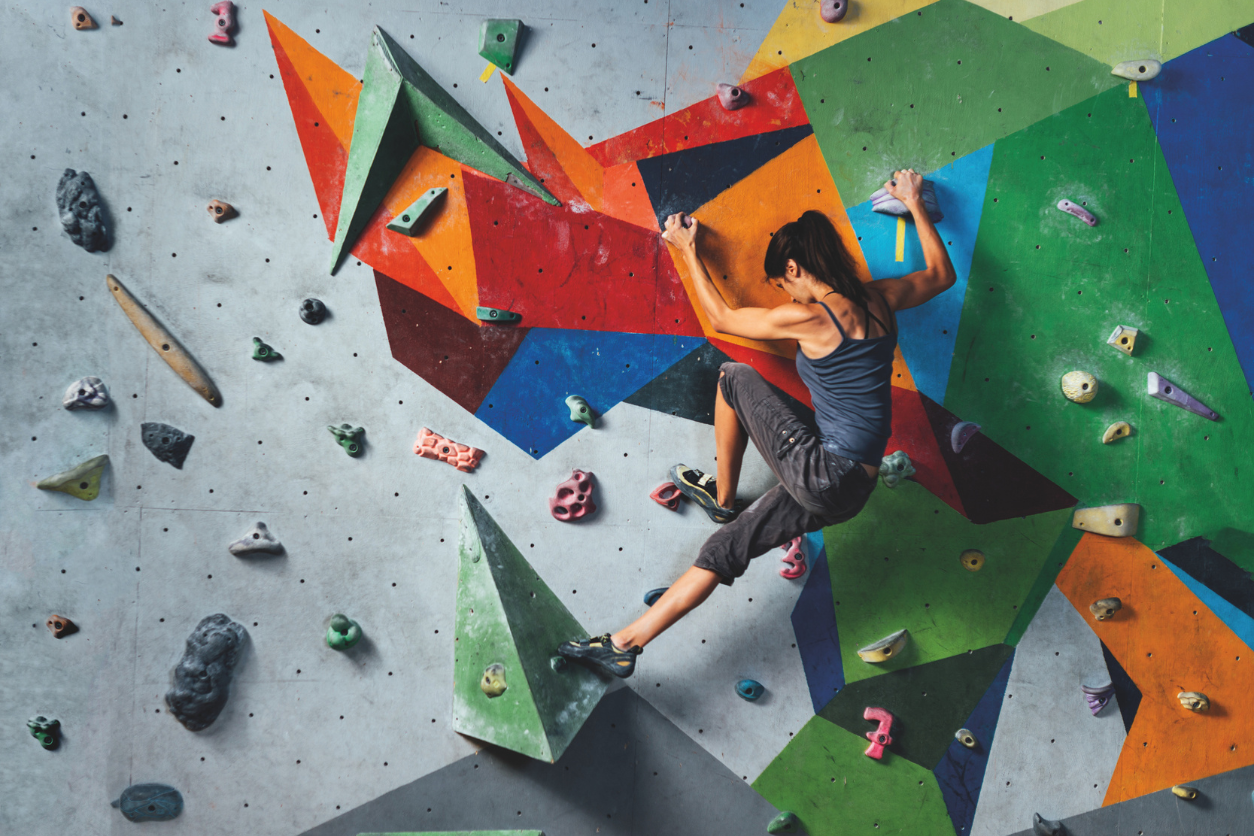
Bouldering, which is climbing rocks/artificial walls at a low height with crash mats below for safety, has played a big part in the climbing boom thanks to its accessibility. Unlike roped climbing, which requires specialist equipment and skills, bouldering just requires climbing shoes and a crash mat/pad to get started. This means anybody willing and able can jump on and experience the thrill of rock climbing with little or no experience. Completing bouldering routes known as ‘problems’ provides a mental and physical challenge which is a great workout, develops problem-solving skills and provides a fun and positive social environment. Climbing has a strong and welcoming community.
If you are fit and sporty, the likelihood is that you have considered trying climbing, you know somebody who climbs or you have already dabbled yourself. Have you ever wondered what attributes make a good boulderer? How could you adapt your gym training to help improve your bouldering ability? What is the best way to make fast progress as a beginner and impress your bouldering buddies? Come and hang out with me as we dip into the addictive world of climbing walls.
The learning curve when beginning climbing is rapid and the progress is addictive. There is a really clear grading system of increasingly difficult climbs, which helps you to map your progress and develop your climbing goals. In bouldering, the grading system, known as the ‘V scale’, starts from V0 and progresses through to V17 and above. The vast majority of progress when beginning climbing comes from learning good climbing technique, but being physically fit definitely gives you a head start and developing climbing-specific fitness helps progress and prevents performance plateaus further down the line. Bouldering requires a number of physical attributes, all of which can be learned/trained for improvement.
“Having an awareness of your centre of gravity in a variety of positions pays off”
Strength endurance
It quickly becomes apparent that pushing and pulling your way up a wall is a fierce fight against the force of gravity. This often requires physical strength and, for longer routes, you need to sustain that strength. In beginners, it is often strength endurance of the forearms, which is a limiting factor more noticeable in ‘overhanging climbs’ (overhangs are walls that lean back over you, making them more difficult to cling to). Eventually, your arms can burn so much and get so tight that they cease to function, known in the climbing community as ‘getting pumped’.
Explosive power
Power is often required when propelling yourself up a problem. This often means building up momentum into one big effort when stretching for a distant hold or on advanced problems performing ‘Dyno’s’, where you are required to jump from one hold to another.
Balance
Many problems require you to balance in precarious positions or to stay close to the wall with little to hold on to. Having an awareness of your centre of gravity in a variety of positions absolutely pays off. Slab climbs (a climb where the wall is leaning away from you on a slant) are notorious for requiring exceptional balance.
Core stability
Having a strong, stable core will help you keep your hips closer to the wall, which reduces the load on your arm muscles and instead loads the relatively stronger muscles of the legs. There may be times when you only have one or two points of contact on the wall, so stability becomes very useful in preventing falling off.
Flexibility
Having access to flexibility on the climbing wall can unlock moves that make harder climbs seem effortless. I have witnessed the very inflexible come up with ingenious methods of getting to the top of a difficult problem but at the expense of huge amounts of time and effort, where having flexible hips would have allowed them to place a high foot hold and unlocked a graceful economy of motion to the ‘send’ (completion of the problem).
Finger strength
In the world of bouldering, finger strength is held in high regard and is a popular subject of discussion. In the higher grades, finger strength plays an important role in holding small holds and edges. For beginners, finger strength should be less of a concern. Finger strength predominantly comes from increased tendon strength over time. Tendons having a slow blood supply are slower to adapt than muscles and so take longer to condition. Overloading the tendons too quickly can lead to finger injuries and long periods off climbing. It is often therefore recommended that at least one year of general climbing experience is gained before attempting any finger-strengthening protocols, allowing muscles, tendons and other tissues in the hands and forearms to condition and build resilience.
Having looked at what we need to work on in the gym, what does that look like in a gym workout? Firstly, if you are beginning bouldering, I would recommend one or two boulder sessions per week with varied climbing and one or two gym conditioning sessions per week working on developing the aforementioned attributes. Below I have provided two gym sessions for you to try out, as well as some basic tips on developing your bouldering skills on the wall.
Boulder gym conditioning workout A
Complete a full-body warm-up prior to this workout, ensuring that the upper body is fully included, particularly if using cardio machines.
Upper-body conditioning
- Pull-ups: Develop functional pulling strength for climbing.
- Triceps dips: Functional pushing strength is great for improving your ability to ‘mantle’ (pushing yourself up over a ledge).
- Single-arm body rows: Help to balance the development of your back muscles and build ‘lock off’ strength (holding your bodyweight on a bent arm).
Lower-body conditioning
- Supported single-leg squats: Build strength to push yourself up off high footholds.
- Suspended hamstring curls: Develop your ‘heel hook’ strength (pulling into the wall using your heel).
Core conditioning
- Hollow body rock: Builds dynamic core stability.
- Suspended woodchop: Builds whole-body rotational stability that can prevent you rotating off the wall or ‘barn dooring’.
Flexibility conditioning
- Frog stretch: Develops your open hip position, allowing you to stay closer to the wall.
- Shoulder ’T’ stretch: Great recovery stretch for overworked muscles of the mid back.
Boulder gym conditioning workout B
Complete a full-body warm-up prior to this workout, ensuring that the upper body is fully included, particularly if using cardio machines.
Upper-body conditioning
- Dead hang: Teaches you to stabilise your shoulder girdle and build grip strength.
- Reverse flys: Builds wide arm-pulling strength for dealing with holds at full stretch.
- Offset press-ups: Develop shoulder stability for positional control on the wall.
Lower-body conditioning
- Split squats: Build leg-pushing strength from a deep knee bend.
- Deadlifts: Build all-round pulling power.
Core conditioning
- Toes to bar: Develop the core you need to pick your feet up to roof-based footholds.
- Side plank: Build trunk stability for leaning to low and reach holds.
Flexibility conditioning
- Iron cross stretch: Develops hip and mid-back flexibility.
- Calf stretch: A recovery stretch from tip toeing on tiny footholds.
Note: The accompanying video demos for these exercises provide easier versions (option one) and harder versions (option two) for each exercise.
Bouldering tips for beginners
Starting bouldering is very exciting as there is so much to learn and explore: styles, techniques, jargon, grips, shoes, places and people. The progress in the beginning adds to the buzz and progress can be accelerated with these few simple tips on improving your climbing technique.
Hips hips hips
You will hear this a lot but keep your hips close to the wall. This keeps weight on your feet and off your hands, increasing the amount of time you can cling to the wall before you fatigue. Generally, involving your hips in every movement you perform usually benefits technique. Shifting your hips about can help with balance, reach and power.
“Varying the types of climbs you do will make you a better all-round climber”
Long arms
A common mistake from beginners is to pull on the hand holds really hard and to climb with consistently bent arms. Try to keep your arms long and relaxed; sometimes you may need to bend your knees more to do this. Don’t squeeze every hand hold with all your strength but rather just enough strength to prevent you falling off. Using your arms and hands more passively like this gives you better fatigue resistance and keeps you calmer on the more testing climbs.
Vary your climbing
Varying the types of climbs that you do will make you a better all-round climber. Try all angles of walls including slabs, verts (straight), overhangs and roofs. Try all types of holds and learn the different ways to grip them. Try to avoid just sticking to your favourite styles and challenge yourself. In the first year of climbing, you just need to climb as many metres as you can and have as much fun as possible.
There are some great tips here to get you started and some fantastic books and websites out there to continue your bouldering journey. Try something different, enjoy with friends and explore what your body is capable of. Go climb.
Get more of Stephen Tongue’s expertise in this pull-up masterclass on the FitPro blog.