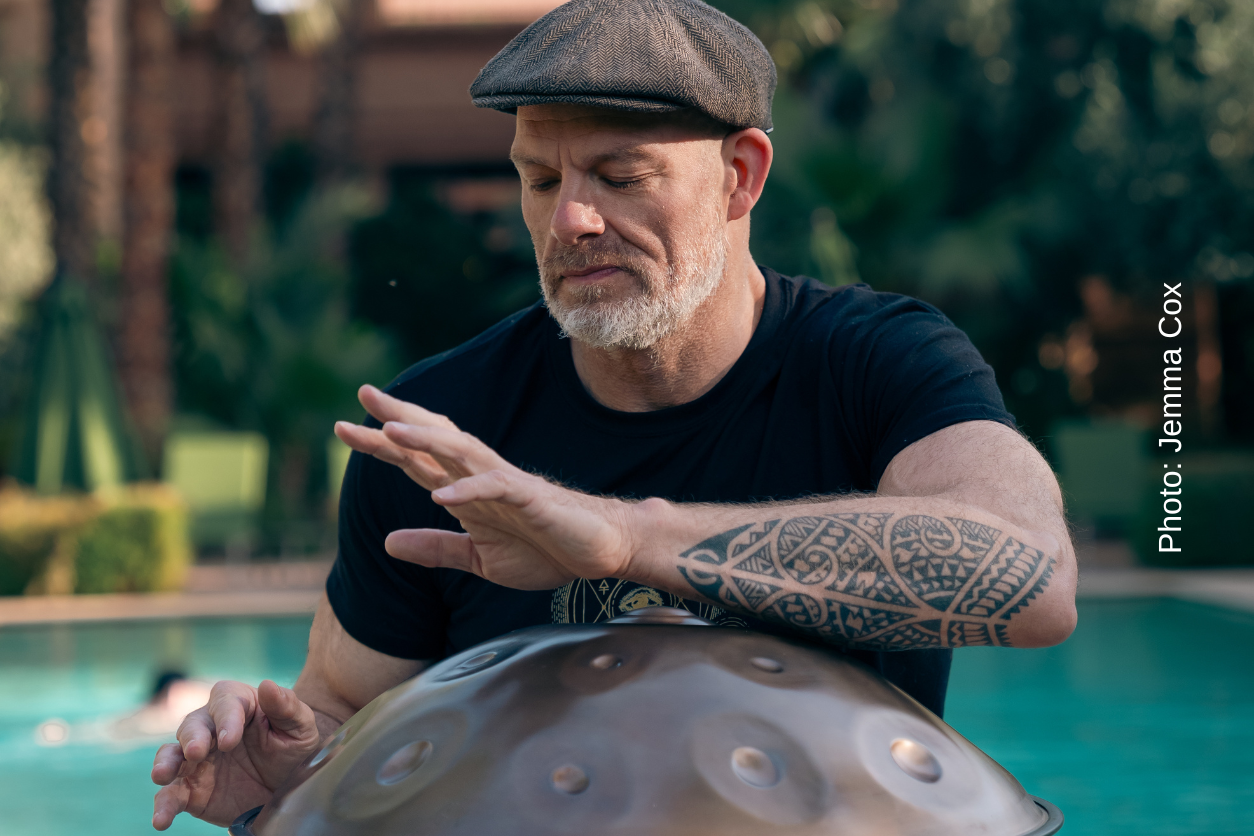
Aislinn Kelly chats to three FitPro members who have incorporated sound healing into their work to support their clients’ nervous systems.
For decades, the fitness industry has been defined by output: intensity, effort, sweat and results. We have become highly skilled at teaching people how to push harder, lift heavier and move faster. But as client needs evolve – and as many professionals themselves experience burnout, injury or fatigue – a quieter, more restorative question is emerging: How well do we support people to recover?
Across studios, gyms and wellness spaces, sound healing is increasingly being explored as a complementary practice – one that supports nervous system regulation, recovery and long‑term sustainability. Here we bring together insights from three FitPro members with different perspectives: Claire Lincoln, a long‑standing group exercise instructor who began integrating sound baths into her fitness offering; James Hunter Crossley, an educator who trains fitness professionals in sound bath facilitation; and Karen Murrie, an experienced instructor who decided to train in sound healing later in her career.
From movement to stillness: Claire’s journey into sound
Claire has spent most of her professional life leading group exercise classes. Movement, rhythm and connection have always been central to her work. So, when she first encountered sound healing, it didn’t feel like a departure from fitness, it felt like an extension of it.
Her introduction to sound baths came at a personal turning point. Despite being active and experienced in movement, she struggled with relaxation, focus and long‑term insomnia throughout much of her adult life. Her first sound bath left her intrigued rather than relaxed – she found herself watching the facilitator, curious about the process – but the following day she noticed something unexpected: energy rather than exhaustion.
On her second experience, she allowed herself to fully receive the sound. Eyes closed, body still, she entered a depth of rest she hadn’t previously accessed. That was the moment she knew sound needed to become part of her work.
What made the transition possible was trust. Claire had built long‑term relationships with her fitness clients. Introducing sound baths wasn’t about abandoning movement; it was about offering a different doorway into wellbeing.
Why sound works alongside movement
From Claire’s perspective, sound and movement are not opposing practices – they are complementary. Traditional sound baths often involve stillness but many clients arrive carrying physical tension from long periods of sitting, stress or inactivity. In these cases, asking the body to immediately relax can be challenging.
“Sound can work well alongside movement practices such as yoga and Pilates”
By integrating gentle movement practices such as yoga or Pilates before a sound bath, Claire notes that the body is warmed, energy shifts and muscular tension begins to release. When sound and vibration are then introduced, the nervous system is more receptive.
“Sound can work well alongside movement practices such as yoga and Pilates,” she explains. “During a sound bath, an individual may lie or sit still and, if they are stressed, tense, haven’t moved much all day or have been working sitting down, their muscles are not warmed up. Their energy is therefore stuck. By getting the body moving, we can begin to warm muscles and shift energy ready for the sound and vibration to be more readily received by the body. Starting with movement (like yoga or Pilates) helps release physical tension in the muscles and joints.”
Physiologically, this combination supports a transition into the parasympathetic ‘rest and digest’ state. Movement prepares the tissues; sound takes the system deeper. Claire consistently observes that clients experience a level of relaxation greater than what they achieve from either practice alone.
What happens in the body during a sound bath?
One of the most compelling reasons fitness professionals are becoming interested in sound is its effect on the nervous system.
“Over time, regular sound sessions appear to support recovery, immune function and consistency in training.”
Claire highlights the role of the vagus nerve – a major pathway connecting the brain to the body. She explains that, during sound baths, vocal toning is often used and, because the vagus nerve connects directly to the voice, this stimulation sends calming parasympathetic signals throughout the system. This can influence heart rate, digestion and overall stress response.
Sound healing traditions also work with the concept of chakras. Claire elaborates, “Each chakra corresponds with a major endocrine gland – the system that secretes hormones to regulate everything from stress and metabolism to fertility and sleep. Science may not measure chakras the same way, but what it does recognise is the mind-body connection and how stress, breath and awareness influence the nervous system and hormones.”
For many clients, Claire has found that the outcome is tangible: clients have reported improved sleep quality, reduced inflammation, less arthritic pain and greater mental clarity. She adds, “Over time, regular sound sessions appear to support recovery, immune function and consistency in training.”
Client perception: From scepticism to curiosity
When Claire first introduced sound baths, client reactions were mixed. Early adopters were predominantly female and some clients were openly sceptical, viewing sound healing as “too woo‑woo”.
However, something shifted. As scientific research into nervous system regulation, stress reduction and recovery became more widely discussed, curiosity replaced doubt. Male participation increased. Clients who were initially unsure began attending out of interest and often stayed because of how they felt afterwards.
This openness has extended beyond studios. Claire now delivers sound baths in diverse settings: pubs, florists, cafés, candle shops, churches and outdoor forest spaces. The portability of sound has allowed her business to expand into new communities and revenue streams, elevating her fitness offering into a broader wellness experience.
A bigger industry shift
Claire doesn’t see sound as a passing trend. She views it as part of a longer‑term shift in fitness and wellness – a response to chronic stress, technology overload, mental health challenges and lifestyle imbalance.
As modalities such as reformer Pilates grow in popularity, the industry is already moving towards more mindful, controlled and nervous‑system‑aware practices. Sound fits naturally into this evolution.
Perhaps the biggest surprise for first‑time participants, according to Claire, is time distortion. Claire concludes, “One of the main things I hear is that people cannot believe how quickly the time has flown. I explain it’s to do with the shift in the brainwaves from using our left analytical side of the brain to the right side, leaving us feeling relaxed and unaware of time. This is often explained through changes in brainwave activity – a shift from analytical, time‑aware states to more relaxed, intuitive ones.”
Training the trainers: James on sound as a missing link
While practitioners like Claire were integrating sound organically, James noticed a gap from an education perspective.
Despite sound healing’s growing popularity, there were few structured, high‑quality training programmes in the UK – particularly ones designed specifically for fitness professionals. At the same time, James was witnessing the powerful effects sound had on relaxation, sleep, anxiety and nervous system regulation.
In fitness education, he observed a familiar pattern: exceptional training in stress application but very little guidance on stress regulation. “In the fitness world, we’re exceptional at pushing the body – strength, conditioning, endurance,” James notes, “but we rarely teach people how to truly switch off. Relaxation is a skill and it’s one that’s often overlooked. Sound, especially through gongs, offers a powerful way to guide people into deep restorative states that support recovery, stress reduction and overall wellbeing.”
“Fitness professionals…understand stress adaptation, overload and the importance of rest days. Sound healing fits beautifully into that framework because it supports the nervous system, which ultimately governs everything from sleep quality to hormonal balance to recovery capacity.”
After experiencing the benefits of sound baths himself, James spotted an opportunity to bridge that gap. He wanted to create professional training that would give coaches, trainers and wellness practitioners the confidence and credibility to integrate sound into their work safely and effectively.
Why sound resonates with fitness professionals
James believes sound resonates so strongly with those from a fitness background because, over time, professionals naturally begin to see health through a wider lens. He says, “When you first enter the industry, the focus is often very physical – strength, aesthetics, conditioning. But, as coaches mature and as clients get older, there’s a deeper appreciation for longevity, recovery and mental resilience. You start to realise that health isn’t just about how hard you can train, it’s about how well you can recover.”
He continues, “Fitness professionals are already highly attuned to the body. They understand stress adaptation, overload and the importance of rest days. Sound healing fits beautifully into that framework because it supports the nervous system, which ultimately governs everything from sleep quality to hormonal balance to recovery capacity.”
James notes that many trainers also arrive at sound through personal burnout. Long hours, high emotional output and constant physical demand take their toll. Experiencing a properly facilitated sound session often creates an immediate ‘click’ – not as something mystical, but as regulation.
Filling the gaps in traditional education
James is clear: sound is not about replacing strength or conditioning. It’s about completing the equation. “Traditional fitness education has historically focused on output,” he explains. “How much you can lift, how hard you can train, how far you can push. There’s often an unspoken belief that annihilating the body is what drives progress. But sustainable performance isn’t about annihilation – it’s about intelligent stimulation followed by proper recovery.”
He continues, “When you push the body hard, you’re stimulating the nervous system. If you don’t also create structured opportunities for recovery, you end up with elevated cortisol, poor sleep, fatigue and eventually burnout or injury. In many cases, it’s not the training itself that’s the issue – it’s the lack of nervous system balance around it.”
One of the most significant mindset shifts James observes is a redefinition of rest, from something passive or indulgent to something essential and active. When trainers feel the physiological response themselves – slower breathing, softened muscle tone, altered heart rate – sound stops being a concept and becomes embodied understanding.
“Sound isn’t a trend. It’s physics… the body responds to vibration, regardless of how it’s branded”
“Another shift is in how they view vibration and the human body,” James explains. “As fitness professionals, we’re comfortable working with biomechanics and physiology. But when they begin to understand how frequency and resonance can influence the nervous system, mood and recovery, it expands their framework of what ‘training’ can mean.”
James points out that people are often surprised how much can surface during a sound session. People report seeing colours, feeling strong vibrations and even revisiting old memories. “There’s a reason we say ‘the issues are in the tissues’,” he says. “Stress and emotion are stored physically and, when the nervous system feels safe enough, things can release.”
Avoiding the ‘trend trap’
James is firm on one point: sound isn’t a trend. It’s physics. He notes that the body responds to vibration, regardless of how it’s branded. His training focuses on nervous system science, safe facilitation and real‑world application, not social media aesthetics.
James finds that a common mistake among new facilitators is underestimating the depth of the work. Playing an instrument is not the same as holding a regulated, safe space. Understanding how sound journeys are structured, how emotional responses may arise and how to support clients afterwards is essential. Like any discipline, James points out, sound requires practice, sensitivity and respect for its impact.
A mid‑career perspective: Karen’s story
Karen brings another vital perspective, that of a seasoned fitness professional stepping into sound later in her career.
With 25 years of teaching experience and a demanding schedule of 17 classes per week, she was no stranger to fatigue. Sound baths entered her life as a way to relax after long working weeks. Initially, she invited local practitioners to deliver sessions for her members, witnessing first hand the positive impact on mental wellbeing.
At 58, Karen wasn’t looking to slow down – she was looking for a new challenge. Training very recently in sound healing didn’t come with fear or doubt, only curiosity. She wondered briefly whether the bowls would ‘like her’ but quickly learned that sound is about relationship, not perfection.
Sound as a companion to experience
Karen’s timetable already includes a wide range of classes, from aerobics and Nordic walking to Pilates and stretch. Adding a monthly sound bath feels like a natural progression.
Learning about sound has fundamentally changed how she viewed recovery. It has helped her recognise that wellbeing isn’t built on constant output, especially during midlife and menopause, when the body demands a different kind of care.
Her clients’ responses have been overwhelmingly positive to the new addition to her timetable. Some have never heard of sound baths, while others have misunderstood what they involve. However, curiosity has replaced uncertainty.
Karen says, “I think my members will enjoy the ‘me time’ as it’s so hard (especially for midlife women) to find this. I am also a Holistic Coach and work with midlife ladies and one thing that always comes out in our programmes is that we’re all so busy spinning so many plates – working, looking after grandchildren and elderly parents, etc. Sound adds another string to my bow and I’m hoping people will know to come to my classes for the ‘whole package’, not just the fitness side.”
For Karen, sound also offers something personal: a chance to slow down. To be, rather than do. In a career defined by energy and communication, silence and stillness have become valuable teachers.
More than a modality
Across all three stories, a common theme emerges: sound isn’t about adding another service. It’s about changing the relationship fitness professionals have with rest, recovery and regulation.
According to our three practitioners, sound healing doesn’t dilute fitness – it deepens it. It reminds us that strength is not only built through effort but through restoration. They all state that a truly complete fitness offering doesn’t just challenge the body, it supports the nervous system that drives it.
Final thought for fitness professionals
Meaningful facilitation comes from repetition, connection and understanding how the sound affects the room. As James states, “The magic isn’t in ‘bashing’ for an hour – it’s in mastery. Practice your instrument. Learn your craft. Respect the depth of the work.”
If the future of fitness lies in longevity, resilience and whole‑person health, then practices that support nervous system regulation are no longer optional; they could be viewed as essential.
Sound healing is growing because people are genuinely feeling the benefits. Gong baths and sound sessions are now common in yoga studios, wellness spaces and even gyms, which creates real demand for trained facilitators.
As James states, “For fitness professionals, sound healing adds another string to the bow. It allows you to expand your offering, attract a broader client base and diversify your income streams, whether through workshops, group sessions or retreats.”
He concludes, “It also brings variety into your work. Not every session has to be high intensity. Offering both stimulation and restoration makes you a more complete practitioner – and that’s increasingly what clients are looking for.”
James Hunter Crossley can be found at https://soundhealingteachertraining.com/ and on Instagram @mrjamescrossley
Claire Lincoln can be found at Mindbodyfitnesswithclaire.co.uk, on Facebook at Mind Body & Fitness with Claire and on Instagram @mindbodyfitnesswithclaire
Karen Murrie can be found at https://glow-fit.co.uk/coach/karen-murrie-glow-ayrshire/ and on Facebook at GlowAyrshire
Main feature photograph: Jemma Cox

Aislinn Kelly
Aislinn Kelly is FitPro’s sub editor and writer, having been in the FitPro team since 2009.