
Morcombe Coulson discusses velocity-based training, a method of resistance training based on velocity to inform or enhance practice.
Micro-electro-mechanical systems (MEMS) that obtain sport performance measures during training or competition are now in widespread use by coaches in many sports and events. Devices with built-in transducers and accelerometers, which are inexpensive and non-invasive, can be used to measure the intensity, directionality and magnitude of an athlete’s movements. Devices can be attached to the athlete or a barbell to provide instant feedback in relation to acceleration performance.
As well as being used for testing variables such as power (peak, average, set average) and velocity (peak, average, set average), devices such as these enable the practitioner to implement what is known as velocity-based training (VBT), which is essentially a method of resistance training based on velocity to inform or enhance practice.
It is widely known that the number of completed repetitions of a given % of 1RM differs between individuals with the intention often cited as the cause of the difference. This simply means that some will try harder than others and therefore achieve different results! For this reason, VBT has been suggested as an alternative training method that can produce instant objective data. Contemporary research has suggested there are three main applications for using VBT:
- Estimating 1RM – some researchers have used the relationship between velocity and %1RM to estimate 1RM.
- Prescribing load – volume and relative intensity can be manipulated depending on the magnitude of velocity loss.
- Velocity feedback – it has been demonstrated that real-time velocity feedback can increase motivation and competitiveness.
Load-velocity profiling
Like any training variable, it is important to establish a baseline so that programmes can be manipulated based on relevant information. One method of using VBT is to create a load-velocity profile, which monitors velocity of the movement against %1RM over time so that future training sessions can be monitored (squat, deadlift and bench press are typical exercises that are used to create load-velocity profiles). Table 1 provides a protocol for developing a load-velocity profile, assuming the 1RM is known.
Table 1: Protocol for developing a load-velocity profile
| Step | Description |
| 1 | Subject completes a standardised warm-up. |
| 2 | Subject completes three repetitions at 20%, 40% and 60% of 1RM after being informed to perform at their maximum capacity. Record the repetition with the fastest mean velocity (MV) for each set. |
| 3 | Subject completes one repetition at 80% and 90% of 1RM. Record the MV for each set. |
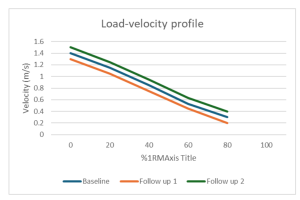
Once data has been collected, velocity against %1RM can be plotted on a graph and a line of best fit applied. Table 2 shows an example of data recorded from three separate profiles of a specific lift – first at baseline, then Follow-up 1 at four weeks and Follow-up 2 at eight weeks. The time between follow-up profiles is dependent on many factors such as training status, periodisation phase and recovery, but is often used to provide information across training sessions.
Table 2: Example data (baseline, four weeks and eight weeks)
| Mean velocity | |||
| %1RM | Baseline | Follow-up 1 | Follow-up 2 |
| 20
40 60 80 90 |
1.4
1.15 0.85 0.53 0.4 |
1.3
1.05 0.75 0.45 0.32 |
1.5
1.25 0.95 0.63 0.5 |
Data can then be plotted as in Figure 1, which shows the load-velocity profile for all three sets of lifts. It can be seen that the profile in Follow-up 1 is faster than the baseline, which indicates an improvement, potentially in neuromuscular capacity. The profile in Follow-up 2, however, is slower than baseline, which could indicate fatigue or overtraining.
Figure 1: Load-velocity profile for example lifts
Velocity loss threshold
There are many ways in which the profile can be used to inform training. One method that is used to provide information during training sessions is velocity loss threshold (VLT). This is where the practitioner develops a load profile for an athlete performing a lift at a specific percentage of 1RM. The velocity is then tracked in real time during training and, if it falls below a particular threshold (20% for example), then the set is terminated. This type of training is used by practitioners to manage fatigue. For example, during off-season periods, a greater VLT can be implemented (20-40% is common), whereas during in-season the VLT may be smaller (less than 20%).
Note: The practitioner must exercise caution with this type of training. Athletes often sacrifice technique for speed of execution, so it is important to maintain the intended stability and range of motion.
Discover more about developing athletic performance in this post on the FitPro blog on plyometric training.