
If you’re a personal trainer or exercise professional, you may be asking is AI replacing fitness professionals? Justin Price investigates.
Technological aspects of the fitness landscape are evolving at lightning speed. Wearables are smarter, apps offer personalised workouts and AI coaches can track reps, form and even provide basic corrections via your phone. It’s an exciting time but, if you’re a dedicated personal trainer or exercise professional, it might also spark a question: Where do I fit in when a sophisticated algorithm can do so much?
The answer lies in specialisation.
While AI excels as a fitness generalist, the true high-level skill – the one that will define elite fitness professionals in the coming decade – is corrective exercise. Corrective exercise specialists understand the musculoskeletal system and human movement at a depth no algorithm can truly replicate.
Let’s look at the fitness professional vs AI struggle and break down why your expertise as a corrective exercise specialist in The BioMechanics Method is, and will remain, indispensable.
-
Beyond the symptom: 3D analysis
An AI app might recognise that a person’s knee is diving in towards the midline during a squat and suggest, “Push your knees out!” This is valid feedback but it’s fundamentally two-dimensional, symptom-level observation and feedback.
Your corrective exercise specialist edge: As a corrective exercise specialist, you don’t just see a client’s knee shift out of alignment; you can determine why it is happening. Is it due to a muscle weakness, alignment issue or movement impairment? Or a motor control deficit? Or a compensatory pattern originating from the spine? Your trained eye and deep understanding of the kinetic chain allow you to uncover the root dysfunction causing the problem, not just treat the surface-level symptom. You see the intricate 3D puzzle of the human body, not just the flat image.
-
Adaptive, non-linear programming
AI thrives on logic: if A, then B. But human bodies are complex, dynamic and anything but linear and straight forward. A client might arrive for a session feeling stiff from poor sleep, stressed from work or unexpectedly sore from a previous activity or flare up of an old injury.
Your corrective exercise specialist edge: You possess the invaluable ability to adapt client programmes in real time. You can sense their energy, observe their subtle body language cues and pivot the session instantly by modifying exercises, regressing movements or even changing the focus entirely to best serve their immediate needs. AI sticks to the script; you can write a new one instantly that is expertly tailored to the person in front of you.
-
Intricacies of pain science
Movement is rarely purely mechanical. Fear, past trauma, stress and even self-doubt profoundly impact how a body moves and heals. An app might detect if a person is guarding during a movement but it can’t understand why.
Your corrective exercise specialist edge: The BioMechanics Method corrective exercise programmes integrate science and psychology. You have the ability to build trust, address fear-avoidance behaviours, and provide the coaching and cueing necessary to help a client overcome mental barriers alongside physical ones. This complete understanding of the human experience is far beyond the current scope of even the most advanced AI.
-
Tactile and proprioceptive feedback
While tactile feedback devices are emerging, they can’t replace the nuanced power of human touch.
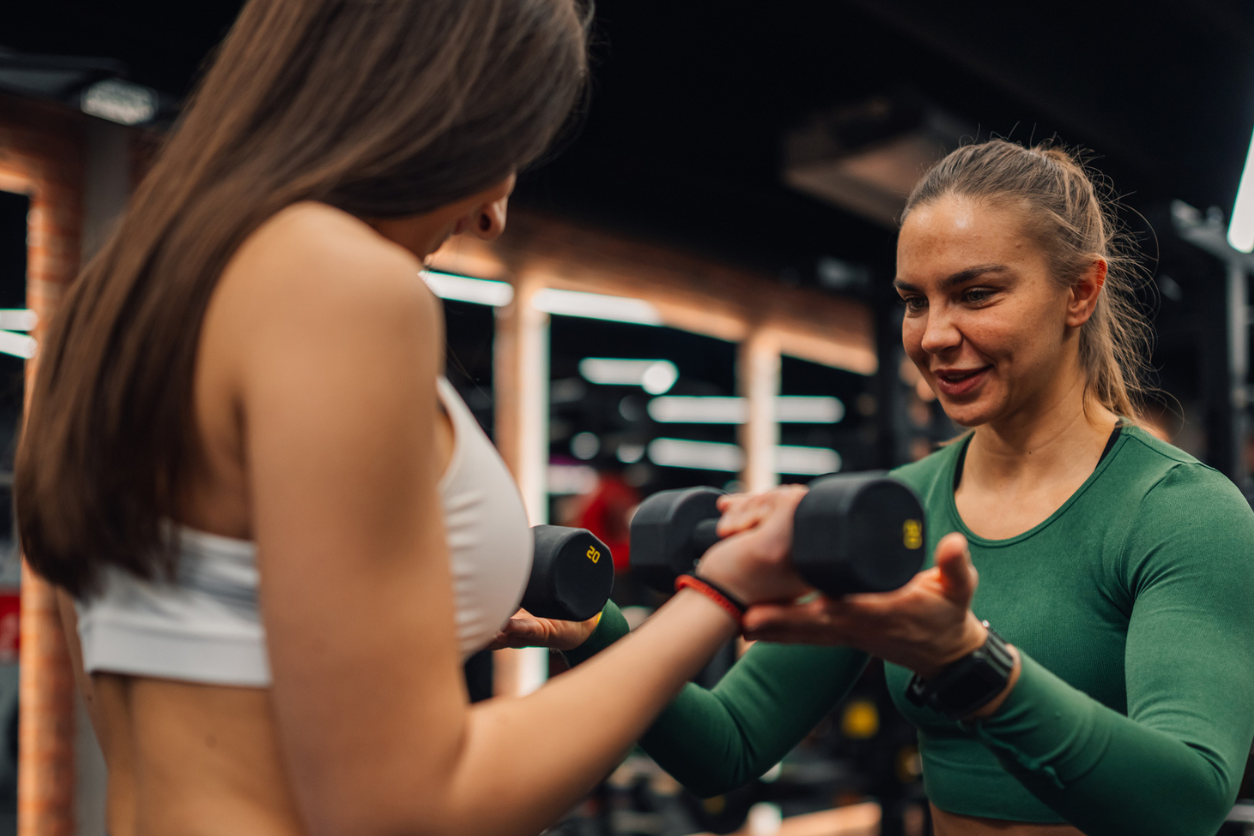
Your corrective exercise specialist edge: Your ability to provide gentle manual cues like a finger placed on a muscle to encourage activation, a slight adjustment to a client’s posture to improve awareness, or hands-on assistance to guide a movement pattern provides immediate, powerful proprioceptive feedback. This kinesthetic learning is critical for rewiring faulty movement patterns, a connection no app can forge.
-
Mastery of multi-planar movement
Most AI analysis is limited to the sagittal (forward/backward) and frontal (side-to-side) planes. Yet, many of the most critical compensations and performance limitations occur in the transverse plane.
Your corrective exercise specialist edge: You can observe and assess movement in all three planes simultaneously. You are able to detect subtle rotational imbalances, understand how they cascade through the body and design corrective strategies that integrate multi-planar stability and mobility. This 3D perspective is where true corrective exercise magic happens.
For the foreseeable future, AI can be relied upon to count reps, track metrics and provide valuable general guidance. It is a digital generalist that can ‘see’ movement and record data at a scale humans can’t. But AI lacks the deeper ‘why’ and intuition that you can provide as a corrective exercise specialist. When it comes to truly solving the complex puzzles of human movement, preventing injury, enhancing performance and fostering genuine wellbeing, the human touch remains paramount. That is the distinct and real advantage you have in a world built on algorithms.
If you are a fitness, exercise or health professional interested in learning how to really connect with clients as you assess and correct the underlying causes of their aches and pains, enroll in the industry’s highest-rated Corrective Exercise Specialist certification course from The BioMechanics Method available through FitPro.