

Gordon ‘Big G’ Watson on how to train a gladiator – how a chance interaction on social media led to coaching one of BBC1’s popular ‘Gladiators’. Gordon explains why he always builds training plans on the foundation of mobility.
It all started on social …
Back in May, Jamie Christian – also known as ‘Giant’ from the hit BBC TV show, Gladiators – shared on his Instagram account that he was really getting into playing golf and wanted to improve his game. I saw the post and decided to send him a note, offering the use of my popular golf simulator facilities at my gym. I didn’t expect much to come of it, but Jamie aka Giant replied and asked where I was based. When told him I was over in Bolton in Lancashire, I thought that might be the end of the conversation, seeing as Jamie’s based many miles away in Derbyshire.
But as fortune would have it, Jamie was actually heading to Bolton in the coming weeks to attend an event. We checked diaries and sorted it so that Jamie would come over to my gym during the weekend to check out everything on offer, and to get stuck in with a tailored session I’d plan for him – all based around mobility and golf fitness.
I suggested we actually started training through my app before we met – as I do with all new starters to my PT provision. Jamie was on board with the idea, so I started programming for him straight away. He was keen to share that he started seeing results quickly from this point, and this put us in an even stronger position to push the exercises on our plan when we met in person.
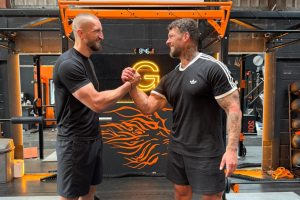
Jamie Christian aka Giant and Gordon ‘Big G’ Watson
Even Gladiators have limits
Being determined to improve his golf game, Jamie was really open about his limitations. He mentioned he had some issues with his lower back and this was something I could definitely relate to. Like Jamie, I’m also well over six feet tall (in fact – I’m three inches taller than Giant himself!). When you’re tall, there’s a lot of pressure going through your lower back and thoracic spine, and even the most talented golfer can struggle and stall with this issue.
As a bodybuilder, Jamie has sculpted a fantastic upper-body frame (obviously he has massive legs, too), but the downside is that all that weight is pressing down and putting pressure on his vertebrae. I did bodybuilding for a while myself, so it turned out that Jamie and I had even more in common than I’d first thought. We quickly built a relationship (key in any coach-client contract) and I officially became Jamie’s strength and mobility coach.
One of our goals was ultimately helping Jamie to reduce his golf handicap, which is something I specialise in having been a competitive golfer since my teenage years. Though ‘Giant’ has that Gladiator name for a reason, I’m always quick to share that we don’t work on the bodybuilding side of his size and strength. Jamie’s absolutely sorted with that side already, but we do work on strength around his core, glutes and obliques as we primarily work to master his mobility.
A whole-body approach to mobility
When it comes to mobility training, I take a whole-body approach. With every client I work with, I focus on mobility before we get into working on anything else. My focus is on improving range of motion and addressing areas of the body that might be underperforming or overcompensating. I noticed straight away that one of Jamie’s key limitations was his hip flexibility, which was most likely a big factor in his back pain. This is something we’re currently working on right now – and consistently improving as we go!
In mobility training, a great coach will always address and assess the whole body. As an example, if you have tight ankles, your body will more than likely compensate in other areas – such as the knees and hips – and that can lead to injury, pain and difficulty moving over time. It’s never just about where pain initially presents. I wish more people knew that.
“Being a tall guy, I’ve always suffered with a lower back issue, chronic low-level pain and being uncomfortable. As I get older, functional training and mobility is definitely something I see as a superpower.” Jamie Christian aka Giant
In my sessions with Jamie, we concentrate on mobility exercises that really focus on his ankles, knees, hips, lower back, shoulders and wrists. For example, I include rotational movements like thoracic extension and side twists in Jamie’s training, which help to really open up his back and improve his range of motion. We also always incorporate a Jefferson Curl, which involves standing on a step and slowly lowering towards the floor, tucking the chin down and opening up the vertebrae on the way down – before slowly returning to the start position. This helps alleviate pressure through Jamie’s joints and is regularly an enjoyable part of his warm-up routine.
As well as focusing on these tighter areas, we’re also mindful not to miss the other aspects. On push days, we focus on chest, shoulders and wrists. On pull days, we emphasise his lower back, hips and shoulders. On leg days we target ankles, knees and hips. I always make sure to include a little bit of everything throughout the week, because mobility isn’t just about one part of the body – it’s about balancing every area for overall movement improvement.
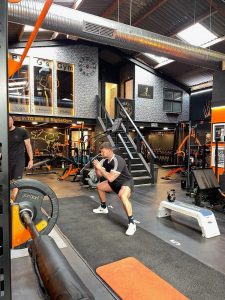
Jamie aka Giant working on mobility in Gordon’s gym
It’s no longer just about golf …
As we’ve progressed in our training, Jamie’s realised that the mobility training isn’t just benefitting his golf game. He’d torn his bicep during previous filming on the show and was going through rehab for that injury, but the mobility work we were doing was helping with his recovery from that, too. This wasn’t just about golf any more; it was about Jamie moving better and feeling better overall.
Jamie is a huge advocate for mobility training. It’s given him the freedom to move better, recover quicker and perform more effectively at his best. A quote from the man himself: “Being a tall guy, I’ve always suffered with a lower back issue, chronic low-level pain and being uncomfortable. As I get older, functional training and mobility is definitely something I see as a superpower. Gaining more mobility, increasing my range of motion and lowering any pain has made me a more powerful and more mobile human being and athlete.”
Key takeaways for mobility training
One of the most rewarding things about coaching is watching people discover the power of mobility training. What I’ve learned through my experience with Jamie is that mobility isn’t just for athletes. It’s for anyone looking to improve their movement patterns, prevent injuries and generally feel better in their bodies.
Becoming more mobile is definitely a superpower – but that doesn’t mean you have to be a Gladiator. Getting it right will unlock freedom of movement you never thought possible.
Consistency is key – you don’t have to kill yourself with 50 exercises a day. In fact, 20mins daily is all you need and, if we really want it and believe in the benefit, we can all find that time somewhere.
Me and my team are now working with more athletes – notably former professional footballer Jermaine Beckford and two-times European Long Drive Champion Bry Roberts. Both are benefitting from training with us and singing our praises (which of course we’re on board with). We don’t just train athletes though, and everybody is welcome at our gym and in our sessions. Everybody deserves to be more mobile!
So, if you’re serious about improving your own (or your clients’) performance – whether that’s in golf, bodybuilding or anything else fitness-focused – never underestimate the importance of mobility. It might just be the element that moves your success forward.
Like to read more about training celebrities? Head over to Faye Edward’s article on getting intentional in fitness on the FitPro blog.
Gordon ‘Big G’ Watson
Gordon ‘Big G’ Watson is a mobility and sport-specific fitness coach and founder of Functional Performance.